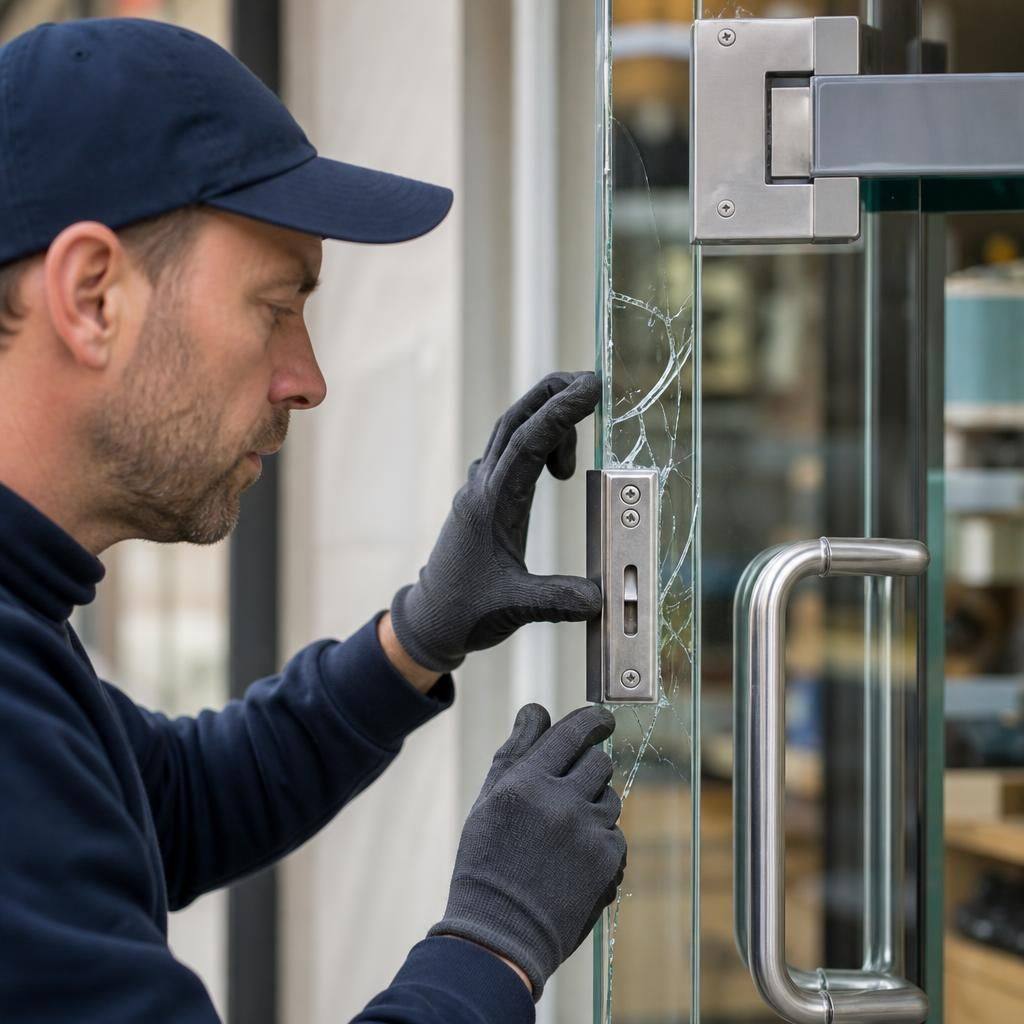

What glass specification is suitable for shop front door repairs?
The suitable specification depends on the door’s design, frame and hardware, but shop front doors will generally require safety glass such as toughened or laminated glass. GlassPlus UK assesses the existing installation and recommends a compliant specification that provides the necessary strength, safety and fit.
The most suitable specification is the one that matches the door system, its hardware and the risks associated with the entrance. In practice, this means selecting the correct safety-glass type, thickness, dimensions and edge treatment rather than treating the replacement as a standard pane.
Toughened glass is commonly considered for shop front doors where impact resistance and a clean appearance are important. It is heat-treated to improve strength and, if it breaks, it normally crumbles into small granular pieces rather than large sharp shards. This makes it suitable for many commercial entrances, provided the surrounding frame and fittings are designed for it.
Laminated glass consists of glass bonded to an interlayer. If the pane is damaged, the fragments generally remain attached to the interlayer, helping the glass stay in place. This can make laminated glass a suitable option where retention, security, noise reduction or additional protection from accidental impact is a priority. The correct choice depends on the door design and the level of protection required; laminated glass is not automatically the best replacement for every entrance.
Some installations use a configuration that combines the characteristics of both types. The appropriate arrangement is determined by the existing glazing system, the dimensions of the pane, the method of fixing and the performance required from the door. A replacement should not be selected solely by matching the visible appearance of the damaged glass.
- Glass thickness and weight: the replacement must be compatible with the door leaf, glazing beads, hinges, pivots, closers and other hardware. An unsuitable thickness or weight can affect alignment, operation and long-term performance.
- Exact measurements: the visible opening is not necessarily the finished glass size. Allowances for gaskets, channels, beads and expansion must be considered when taking measurements.
- Edge preparation: polished, arrissed or otherwise prepared edges may be required depending on whether the edges are exposed, held in a channel or used with particular fittings.
- Hardware cut-outs: doors with patch fittings, locks, handles, floor springs or other fittings may require accurately positioned holes and cut-outs. These details must be established before manufacture.
- Visibility and appearance: clear, tinted, obscure or privacy glass can change the appearance of a shop front and the amount of light entering the premises. The replacement should be compared with adjacent panes where a consistent frontage is important.
Safety considerations also include how clearly the door can be seen by customers, staff and visitors. Manifestation or other visual markings may be appropriate on large areas of transparent glazing, particularly where the door forms part of a wider glazed frontage. The requirement depends on the layout, visibility and use of the entrance.
Where the door forms part of a fire-resisting, acoustic, security or specialist installation, the replacement specification must preserve the relevant performance. Ordinary replacement glass should not be substituted for specialist glazing without checking the complete door assembly and its supporting documentation. The same principle applies to doors with unusual framing, automatic operation or integrated access-control equipment.
GlassPlus UK assesses the existing installation before confirming the specification. This includes examining the frame and hardware, identifying how the pane is retained, checking the condition of the surrounding components and confirming the measurements and required finish. The proposed glass can then be selected for safe use, proper fit and compatibility with the door, with the work carried out in line with current building and safety regulations.
For a business comparing repair options, the key distinction is between a like-for-like visual replacement and a technically suitable replacement. A proper assessment considers the whole door assembly, not just the broken pane, helping to avoid problems with fit, operation or compliance after the repair.
The specification must be finalised before safety glass is manufactured. Toughened glass cannot be cut or drilled after heat treatment, so any holes, notches or other preparation required for the door fittings must be included in the original order. This is why a proper shop front door glass repair considers the complete fitting arrangement before production, rather than selecting a pane based only on its visible size.